
What Morgan County Tax Records Show
A Morgan County tax record is really two records stitched together. The Assessor maintains the yearly appraisal work. That covers land value, building value, total appraisal, map and parcel number, tax class, and exemption details. The Sheriff/Treasurer keeps the money side. That office collects real and personal property tax along with fire and ambulance fees. The figures live in separate systems. Match them by tax year and parcel key first. Doing that before calling about an amount due saves everyone a round trip.
| Field | What It Shows | Where |
|---|---|---|
| Land/building/total appraisal | Assessor's value fields for the stated tax year | Morgan County Assessor |
| Tax class and land use | Classification and land-use indicators | Assessor roll |
| Credits and exemptions | Homestead, senior, farm-use, military, and veteran programs | Assessor forms and office |
| Bill and payment status | Tax amount, current or delinquent status | Sheriff/Treasurer |
| Tax-sale status | Certified land, taxpayer, purchaser, and ticket fields | State Auditor after certification |
Value and billing answer different questions. The Assessor determines true and actual appraised or fair-market value, then assigns a tax class. The office plays no part in setting the levy or collecting payment. The bill shows what was charged under that year's schedule. It also shows what payments posted against it. Neither figure tells a buyer what the property would fetch on the market. To gauge what a valuation means, compare the Assessor's land, building, and total fields with deed and sale data. Skip the bill alone for that purpose.
Morgan County Assessment and Tax Offices
Both offices sit at 77 Fairfax Street. The Assessor is in Room 103. The Sheriff/Treasurer sits next door in Room 104. The Assessor's site carries tax forms, levy rates, and a tax estimator. Homestead and senior credit information is there too. Farm-use valuation, appeal instructions, active-duty military and disabled-veteran credits, map cards, and land books round out the offerings. The Sheriff collects real and personal property tax together with fire and ambulance fees. Route each question to the office that owns the disputed field. A billing question and an appraisal question land on different desks.
The county tax inquiry portal does not always load reliably. Its account fields, receipt options, payment methods, and tax-year coverage may not match what you expect. The official Sheriff page still posts office contacts, current schedules, and the online inquiry link. If the portal stalls, call 304-258-8562 or visit the tax office. Do not trust an old payment screen. The Morgan County Sheriff's Tax Office page also lists the current collection route.
Reading a Morgan County Tax Bill
Start by matching the bill to the property. The tax year and parcel number are the keys. Confirm those before checking whether an account is paid. The Morgan County portal combines tax, fire, and ambulance inquiry services, while the Assessor's roll explains the land and value fields behind the annual assessment. When an account will not come up online, the Sheriff/Treasurer's counter is the fallback. Do not assume the vendor page shows receipts or prior years in any particular way.
- Start with the parcel's tax district, map, parcel, and sub-parcel from the Assessor.
- Use those fields or the taxpayer name in the official tax inquiry or Auditor portal.
- Read the tax year, balance, payment, and status fields shown by that custodian.
- Call the Sheriff if the page is unavailable or the amount does not match the notice.
Looking Up a Morgan County Tax Bill
A Morgan County tax bill and the Assessor's online property card are separate documents. Pull the district and parcel from the roll to avoid a same-name or mailing-address mix-up. For current status, follow the Sheriff's tax page. For a certified delinquent land record, use the State Auditor. The county sends the list over first. A bill search proves what was charged, not who holds title.
- Get the current parcel key from the Morgan County Assessor.
- Open the Sheriff's official tax inquiry and search using the available account or parcel fields.
- Check the year and bill status, then confirm a payment or balance with Room 104.
- For a certified delinquent list or sale status, move to the State Auditor record.
- Assessed value
- The Assessor's value used in the tax roll for its stated year.
- Levy rate
- The rate adopted for taxation; the Assessor does not set it.
- Homestead credit
- A property-tax program listed by the Assessor; verify current qualifications with that office.
- Tax lien
- A claim tied to unpaid real-estate tax and the statutory sale process.
Morgan County Delinquent Tax Path
Morgan County's schedule makes taxes delinquent on May 1 and adds a $3 delinquent fee. A 2022 county notice explains the shift under Senate Bill 552. For delinquent 2021 taxes onward, the State Auditor runs the real-estate lien sale. The Sheriff certifies the list by October 31. Owners redeem through the Auditor once certification happens. Check each year's county notice for current dates, since publication timing can move.
The Auditor's search takes tax year and county. It then adds district, map, parcel, sub-parcel, certificate, taxpayer, purchaser, bidder, description, ticket, account, and status. Only one field is required to start. Treat a certified-to-state result as a lead, not a conclusion. Match it against later Auditor and Clerk instruments before assuming title changed hands. The State Auditor County Collections search is the official route. Morgan County certifies delinquent parcels first.
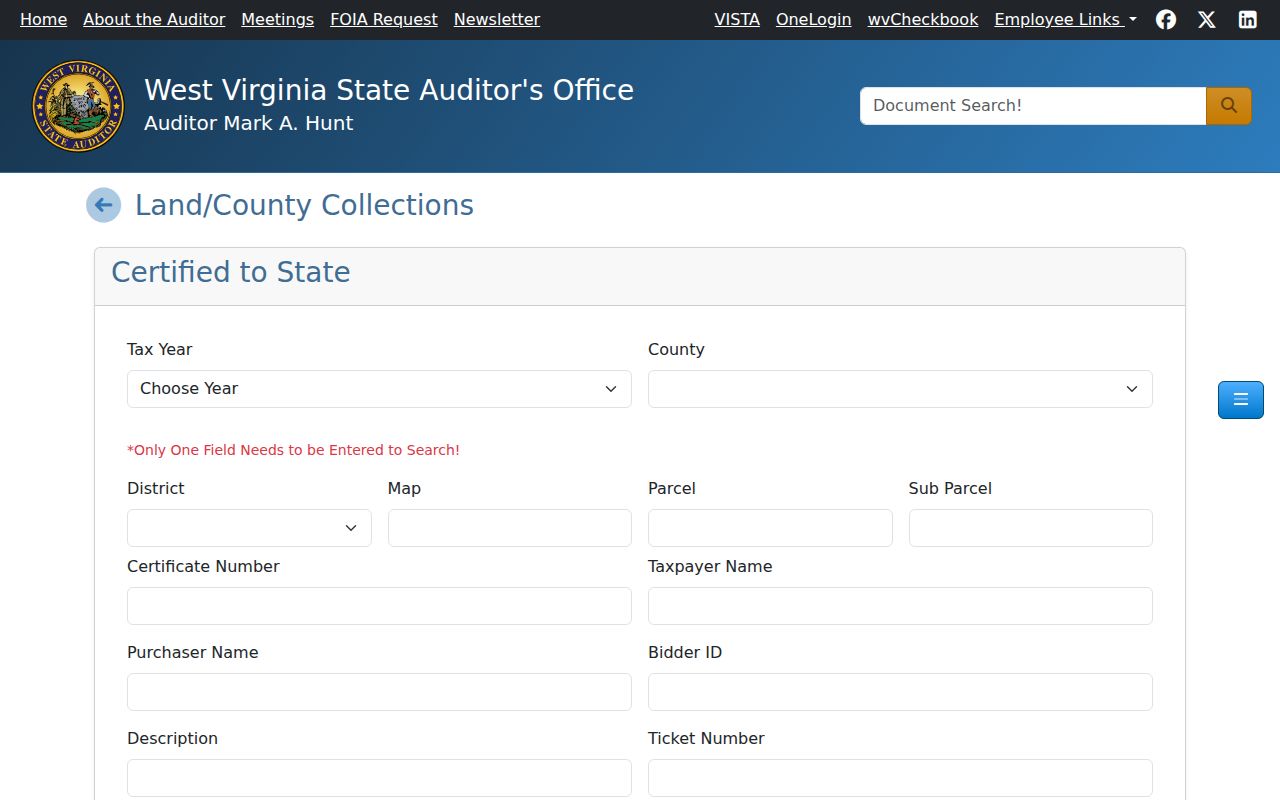
The Auditor form lists parcel keys and party fields, which helps confirm the certified record.
Morgan County Credits and Land Use
The Assessor's tax resources cover homestead and senior credits, farm-use valuation, active-duty military relief, and disabled-veteran credits. Forms and filing dates are included too. Eligibility rules and document requirements come from the current form or the office itself. If an expected credit is missing, compare the annual tax card with the filing confirmation. Do not assume it was granted before doing so.
Tax class and land use shape how a parcel is assessed. A credit changes the amount carried into the bill. A vacant tract, a farm-use entry, a residence, and an improved parcel rarely compare well by total appraisal alone. Read each parcel's own classification. Ask the Assessor about any field that looks wrong. Amounts paid or delinquency questions still belong to the Sheriff/Treasurer. The Morgan County Land Book Viewer offers Year and Book/District controls for historical assessment entries.
Older assessment entries carry a year and book reference.
Morgan County Tax Calendar Notes
May 1 is the 2025 delinquency date. The full Sheriff schedule also describes the later publication steps that follow. A 2026 tax office notice says the county is collecting 2026 taxes. It offered a 2.5 percent discount on the second half for payment by September 1, 2026. That date has passed. It is a dated notice, not a discount promise. Check the live schedule before planning payment or appeal.
Assessment and collection calendars run on separate tracks. A new owner on the deed does not instantly change the annual Viewer. A tax payment does not update the legal description either. For a contest, follow the Assessor's appeal instructions; for a bill, use the Sheriff's payment channel; for a delinquent sale, track the Auditor's status.
Appeal a Morgan County Assessment
Morgan County lays out an eight-day informal protest window. After that, appeals go to the West Virginia Office of Tax Appeals by March 31. Those windows shift with the notice and form. Read the latest instructions or call the Assessor instead of trusting a remembered date. The Assessor's website posts appeal material. It also directs owners to report errors in names, addresses, and other assessment details to the office.
Appeal window. The county instructions describe an eight-day informal protest and a March 31 Office of Tax Appeals deadline. Confirm the notice-specific steps and current forms with the Assessor before filing.